
The Atom
The building blocks of everything — subatomic particles, energy levels, and the numbers that define every element.
Subatomic Particles
The Three Particles
Every atom is made of three subatomic particles. The protons and neutrons live in the tiny nucleus at the centre, while electrons orbit in energy levels (shells) around it.
| Particle | Location | Relative Mass | Relative Charge |
|---|---|---|---|
| Proton | Nucleus | 1 | +1 |
| Neutron | Nucleus | 1 | 0 |
| Electron | Energy levels | Very small (~0.0005) | −1 |
Key Numbers
- Radius of an atom ≈ 1 × 10&supmin;¹&sup0; m
- Radius of the nucleus ≈ 1 × 10&supmin;¹&sup5; m — that's about 100,000 times smaller than the atom!
- Most of the atom is empty space
- In a neutral atom: number of protons = number of electrons
Atomic Number & Mass Number
Reading the Periodic Table
- Atomic number (Z) = number of protons in the nucleus. This defines the element.
- Mass number (A) = protons + neutrons (total particles in the nucleus).
- Number of neutrons = mass number − atomic number (A − Z).
Example: Lithium-7 has atomic number 3 and mass number 7, so it has 3 protons, 4 neutrons, and 3 electrons.
Isotopes
Definition
Isotopes are atoms of the same element (same number of protons) but with a different number of neutrons. This means they have the same atomic number but different mass numbers.
Example: Carbon-12 (6p, 6n) and Carbon-14 (6p, 8n) are isotopes of carbon. They behave identically in chemical reactions but Carbon-14 is radioactive.
Energy Levels & Electron Transitions
Electrons in Shells
- Electrons orbit the nucleus in fixed energy levels (shells).
- The lowest energy level is closest to the nucleus.
- When an electron absorbs electromagnetic radiation, it gains energy and moves to a higher energy level (further from the nucleus).
- When an electron drops to a lower energy level, it emits electromagnetic radiation and moves closer to the nucleus.
Exam Tip
The radiation emitted/absorbed is a specific amount of energy — this links to the idea of line spectra, which provide evidence for energy levels. AQA loves asking about the direction of electron movement and what is absorbed or emitted.
A) Moves closer to the nucleus
B) Moves further away from the nucleus
| Atom | Protons | Neutrons | Electrons |
|---|---|---|---|
| X | 6 | 6 | 6 |
| Y | 6 | 8 | 6 |
| Z | 7 | 7 | 7 |
(a) Which two atoms are isotopes of each other? Explain your answer. [2]
(b) What is the mass number of atom Z? [1]
(b) Mass number = protons + neutrons = 7 + 7 = 14 [1].
(a) What is the atomic number of sodium? [1]
(b) What is the mass number of this sodium atom? [1]
(c) Another isotope of sodium has a mass number of 24. How many neutrons does this isotope have? [1]
(d) Explain why both isotopes of sodium have identical chemical properties. [1]
(b) Mass number = protons + neutrons = 11 + 12 = 23 [1]
(c) Neutrons = mass number − atomic number = 24 − 11 = 13 neutrons [1]
(d) Both isotopes have the same number of electrons (and protons), and chemical properties depend on the electron arrangement, not the number of neutrons [1].
B (Atomic number) = 3 — number of protons in the nucleus [1 mark]
C (Neutrons) = 4 — mass number − atomic number = 7 − 3 = 4 [1 mark]
D (Electrons) = 3 — in a neutral atom, electrons = protons = 3 [1 mark]
(a) What term is used to describe atoms like these, which are the same element but have different mass numbers? [1]
(b) State one similarity and one difference between these two atoms. [2]
(b) Similarity: Both atoms have the same number of protons (6), so they are both carbon / the same element [1 mark].
Difference: Atom P has 6 neutrons (mass number 12) while Atom Q has 8 neutrons (mass number 14), so they have different mass numbers [1 mark].
A Level - February
PHYSICS ONLY
16, 17, 18, 19 Feb 2026
Revision Course
GCSE - Easter
BIOLOGY, CHEMISTRY PHYSICS
7 - 10 April 2026
Revision Course
A Level & GCSE
PHYSICS ONLY
Term - Time
one to one
How You Can Work With Me
Support is offered in clear layers, so students and families can choose what fits best.
Free Community Access
A welcoming starting point with BRIDGE-based resources and introductory courses.
1:1 Specialist A-level Physics Support
Personalised teaching rooted in deep understanding, confidence, and exam success.
Small Group Programmes
Structured learning with motivated peers, focused on thinking, discussion, and application.

About Kate
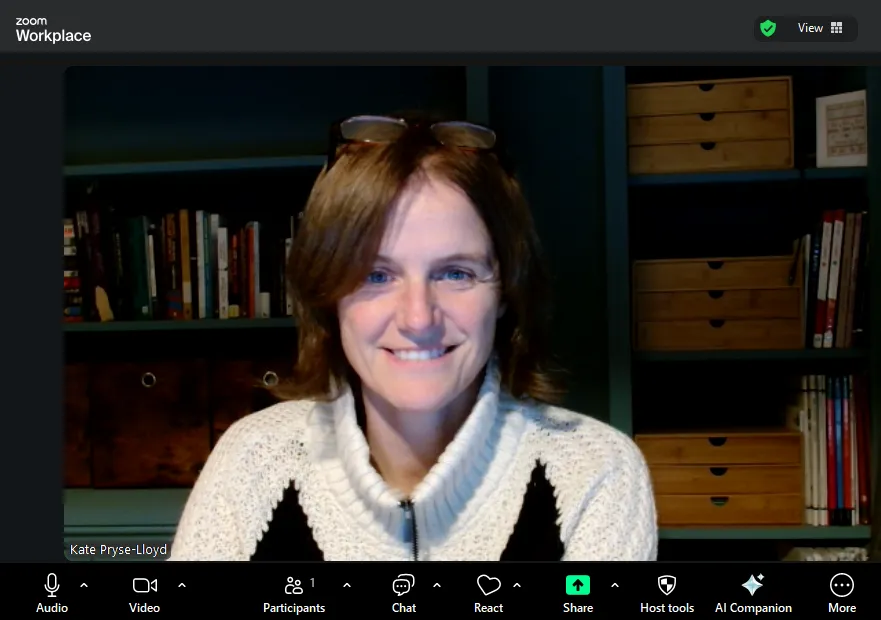
I’m Kate — an experienced Physics teacher, examiner, and the founder of Physics with Kate.
Over more than 15 years, I’ve taught and examined thousands of students and seen first-hand how capable girls can lose confidence in Physics at A-level. I’ve also seen how quickly that changes when teaching focuses on understanding, courage, and belonging.
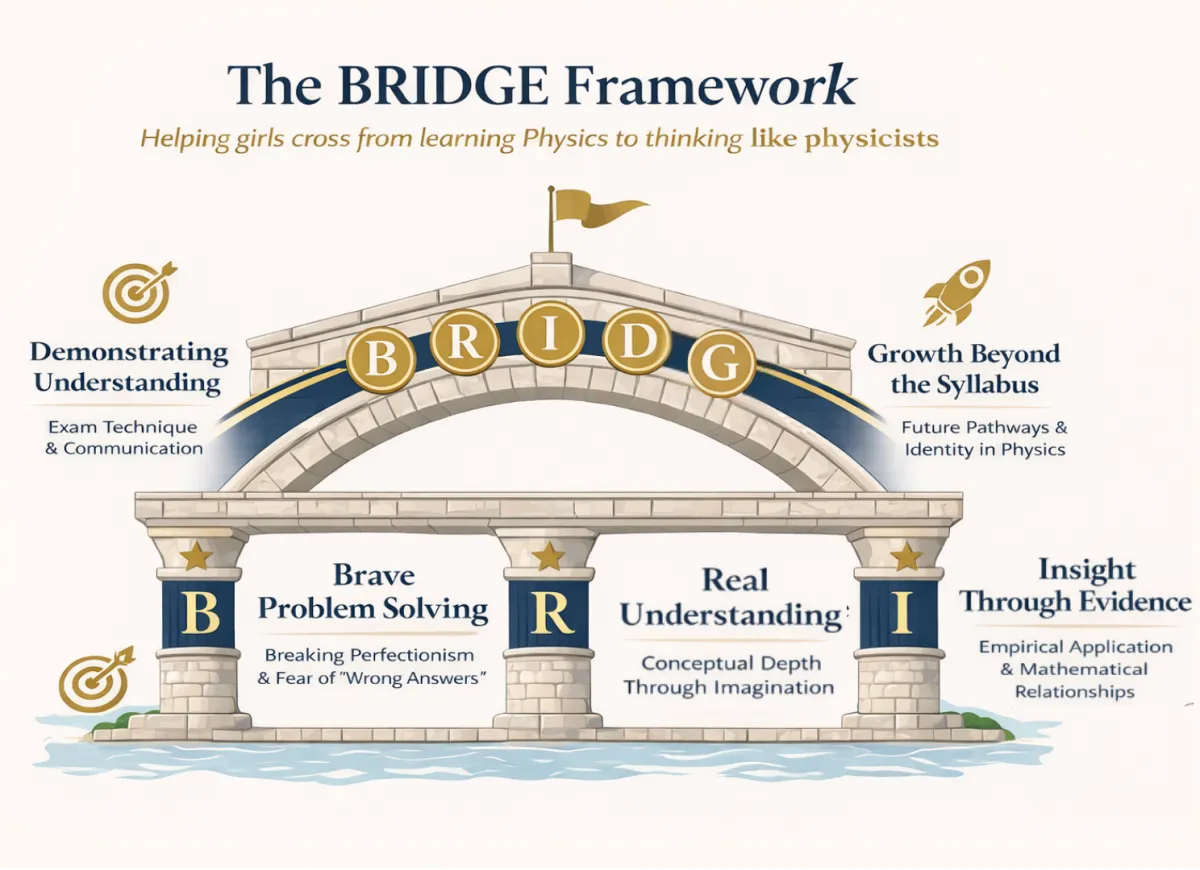
The BRIDGE Framework grew from real classrooms, real results, and a deep belief that girls belong in Physics — and can excel in it.
Ready to Build Confidence in Physics?
Whether you’re looking for structured support, a specialist tutor, or a community that truly understands A-level Physics, you’re in the right place do join my community or book in with me to find out more about I can support you, your department or your child.
A Community Where Girls Belong in Physics
The Physics with Kate Community is a supportive, academically focused space for girls studying A-level Physics.
Inside the community, students have access to:
Free BRIDGE-based mini courses
Brave and opened - Guided problem-solving sessions
Real understanding of the concepts
Insight by applying formulas and calculations to solve problems
Demonstrate understanding with exam technique support and revision resources
Growth, support with UCAS, extra-curricular competitions and projects and industry links
Example Visible sixth formers normalise girls in Physics for younger year groups
Free to join a network of like-minded girls who take Physics seriously
Subscriptions for 1:1 and group tutoring
This is a place where curiosity is encouraged, ambition is normalised, and girls feel confident to ask questions and think deeply.





Facebook
Instagram
X
LinkedIn
Youtube