Nuclear Fission & Fusion — Atomic Structure | Physics with Kate
Topic 08

🔮 Nuclear Fission & Fusion 🔮

Splitting atoms and joining them — the two nuclear reactions that power stations and stars.

💥 Fission
Splitting a large, unstable nucleus into two smaller nuclei, releasing energy and neutrons. Used in nuclear power stations. Fuel: uranium-235 or plutonium-239.
VS
☀️ Fusion
Joining two small, light nuclei to form a larger nucleus, releasing huge amounts of energy. Happens in stars. Example: hydrogen → helium in the Sun.

✦ Nuclear Fission

🎬

How It Works

  • A slow-moving neutron is absorbed by a uranium-235 nucleus
  • The nucleus becomes unstable and splits into two smaller daughter nuclei
  • It also releases 2 or 3 neutrons and a large amount of energy
  • The released neutrons can hit other U-235 nuclei → chain reaction
🩰 Nuclear Fission Chain Reaction
n neutron 235 U 92 141 Ba 56 92 Kr 36 ENERGY n n n 235 U 92 235 U 92 235 U 92 Generation 1 Generation 2 Chain Reaction Key n = Neutron U = Uranium-235 = Daughter nuclei Each fission releases 2–3 neutrons, which each cause another fission event — an exponential chain reaction. In a reactor, control rods absorb excess neutrons to keep the reaction steady.
Uranium-235 absorbs a neutron, splits into barium-141 and krypton-92, and releases 3 neutrons that each trigger further fission events.

Chain Reactions

Each fission event releases neutrons that cause more fission events. In a nuclear reactor, this is controlled using control rods that absorb excess neutrons. In a nuclear bomb, the chain reaction is uncontrolled.

Advantages & Disadvantages

✓ Advantages: No greenhouse gases during operation; small amount of fuel produces huge energy; reliable baseload power

✗ Disadvantages: Produces radioactive waste (remains dangerous for thousands of years); risk of nuclear accidents; high decommissioning costs; uranium is non-renewable

🩰 ✦ 🩰 ✦ 🩰

✦ Nuclear Fusion

🎬

How It Works

  • Two light nuclei (e.g. hydrogen isotopes) are forced together at extremely high temperatures and pressures
  • They fuse to form a heavier nucleus (e.g. helium) and release energy
  • This is the process that powers all stars, including our Sun
🩰 Nuclear Fusion — Deuterium + Tritium
2 H 1 Deuterium (1 proton + 1 neutron) p n + 3 H 1 Tritium (1 proton + 2 neutrons) p n n FUSE millions of °C 4 He 2 Helium-4 (2 protons + 2 neutrons) p n n p + n neutron + E energy Fusion Equation 21H + 31H 42He + 10n + energy
Deuterium and tritium fuse under extreme temperature and pressure to form helium-4, a free neutron, and a huge amount of energy.

Why Fusion Is Hard on Earth

Nuclei are both positively charged, so they repel each other. To overcome this you need temperatures of millions of degrees and extreme pressure. Containing plasma at these temperatures is the key engineering challenge — we haven't achieved sustained, energy-positive fusion yet.

Why Fusion Is the Dream

  • Fuel (hydrogen) is abundant — found in water
  • No long-lived radioactive waste
  • No greenhouse gas emissions
  • Produces more energy per kg than fission
🩰 ✦ 🩰 ✦ 🩰

✦ Summary: Fission vs Fusion

🩰 Comparing the Two Nuclear Reactions
Fission Definition: Splitting a large nucleus into two smaller daughter nuclei Fuel: Uranium-235 / Plutonium-239 Where: Nuclear power stations Products: 2 nuclei + 2-3 neutrons + energy Waste: Radioactive (dangerous for 1000s yrs) Status: Currently used worldwide Chain: Yes — self-sustaining chain reaction Fusion Definition: Joining two small, light nuclei to form one larger nucleus Fuel: Hydrogen isotopes (D + T) Where: Stars (e.g. the Sun) Products: Larger nucleus + neutron + energy Waste: No long-lived radioactive waste Status: Not yet achieved on Earth Chain: No — requires constant input VS
🩰 ✦ 🩰 ✦ 🩰
Question 1 [1 mark]
What is nuclear fusion?

A. The splitting of a large nucleus into smaller nuclei
B. The combining of two smaller nuclei to form a larger nucleus
C. The release of radiation from a radioactive atom
D. The process of atoms losing electrons
✦ Answer
B. Fusion is the joining (combining) of two small, light nuclei to form a larger nucleus, releasing energy.
Question 2 [1 mark]
What are the main products when two hydrogen nuclei fuse?

A. Two smaller nuclei and energy
B. A single helium nucleus and energy
C. Two protons and energy
D. A neutron and energy
✦ Answer
B. Two hydrogen nuclei fuse to form a helium nucleus plus energy.
Question 3 [1 mark]
What name is given to the process where a uranium-235 nucleus absorbs a neutron and splits?
✦ Answer
Nuclear fission.
Question 4 [1 mark]
How does the mass number of an atom change when its nucleus absorbs a neutron?
✦ Answer
The mass number increases by 1, because a neutron has a mass number of 1.
Question 5 [2 marks]
How is the nucleus of a uranium-238 atom different from the nucleus of a uranium-235 atom?
✦ Answer
Both have the same number of protons (92) [1], but uranium-238 has 3 more neutrons than uranium-235 (146 vs 143) [1]. They are isotopes of uranium.
Question 6 [3 marks]
Why is nuclear fusion considered a potential source of clean energy? Give at least two reasons.
✦ Answer
1. The fuel (hydrogen) is abundant and can be obtained from water [1].
2. It produces no greenhouse gases [1].
3. It produces no long-lived radioactive waste [1].
(Any 2–3 for full marks depending on question requirement.)
Question 7 [2 marks]
Describe how a chain reaction occurs in nuclear fission.
✦ Answer
When a uranium-235 nucleus splits, it releases 2 or 3 neutrons [1]. These neutrons can be absorbed by other U-235 nuclei, causing them to also undergo fission, releasing more neutrons, and so on — creating a self-sustaining chain reaction [1].
Question 8 [3 marks]
The diagram below shows a nuclear fission chain reaction. Fill in the three missing labels A, B, and C.
n neutron 235 U 92 A = ? B = ? n n n 235 U 92 235 U 92 235 U 92 C = What is this process called? HINT: A & B are the two types of product nuclei. C describes the overall repeating process.
Identify the missing labels A, B, and C in this fission chain reaction diagram.
✦ Answer
A = Daughter nucleus (one of the two smaller nuclei produced, e.g. barium-141) [1]

B = Daughter nucleus (the other smaller nucleus produced, e.g. krypton-92) [1]

C = Chain reaction — the process where neutrons released from one fission event go on to cause further fission events in other uranium-235 nuclei [1]
Question 9 [3 marks]
The diagram below shows a nuclear fusion reaction. Identify the reactants (X and Y) and the products (Z and W).
2 H 1 X = ? + 3 H 1 Y = ? FUSE 4 He 2 Z = ? + n W = ? HINT: Use the mass and atomic numbers to identify the names of X, Y, Z, and W.
Name the reactants X and Y, and the products Z and W.
✦ Answer
X = Deuterium (hydrogen-2, with mass number 2 and atomic number 1) [1]

Y = Tritium (hydrogen-3, with mass number 3 and atomic number 1) [1]

Z = Helium-4 (mass number 4, atomic number 2) and W = a neutron (mass number 1, atomic number 0). Energy is also released [1].
Question 10 [3 marks]
Explain why nuclear fusion is difficult to achieve on Earth, even though it happens naturally in stars.
✦ Answer
Nuclei are both positively charged, so they repel each other due to electrostatic repulsion [1]. To overcome this repulsion and force the nuclei close enough to fuse, extremely high temperatures (millions of degrees) and pressures are needed [1]. On Earth, containing a plasma at these extreme temperatures is the main engineering challenge — no known material can withstand such heat, so magnetic confinement or laser methods are needed, and so far no method has achieved sustained, energy-positive fusion [1].

A Level - February

PHYSICS ONLY

16, 17, 18, 19 Feb 2026

Revision Course

GCSE - Easter

BIOLOGY, CHEMISTRY PHYSICS

7 - 10 April 2026

Revision Course

A Level & GCSE

PHYSICS ONLY

Term - Time

one to one

How You Can Work With Me

Support is offered in clear layers, so students and families can choose what fits best.

Free Community Access

A welcoming starting point with BRIDGE-based resources and introductory courses.

1:1 Specialist A-level Physics Support

Personalised teaching rooted in deep understanding, confidence, and exam success.

Small Group Programmes

Structured learning with motivated peers, focused on thinking, discussion, and application.

Physics With Kate

About Kate

I’m Kate — an experienced Physics teacher, examiner, and the founder of Physics with Kate.

Over more than 15 years, I’ve taught and examined thousands of students and seen first-hand how capable girls can lose confidence in Physics at A-level. I’ve also seen how quickly that changes when teaching focuses on understanding, courage, and belonging.

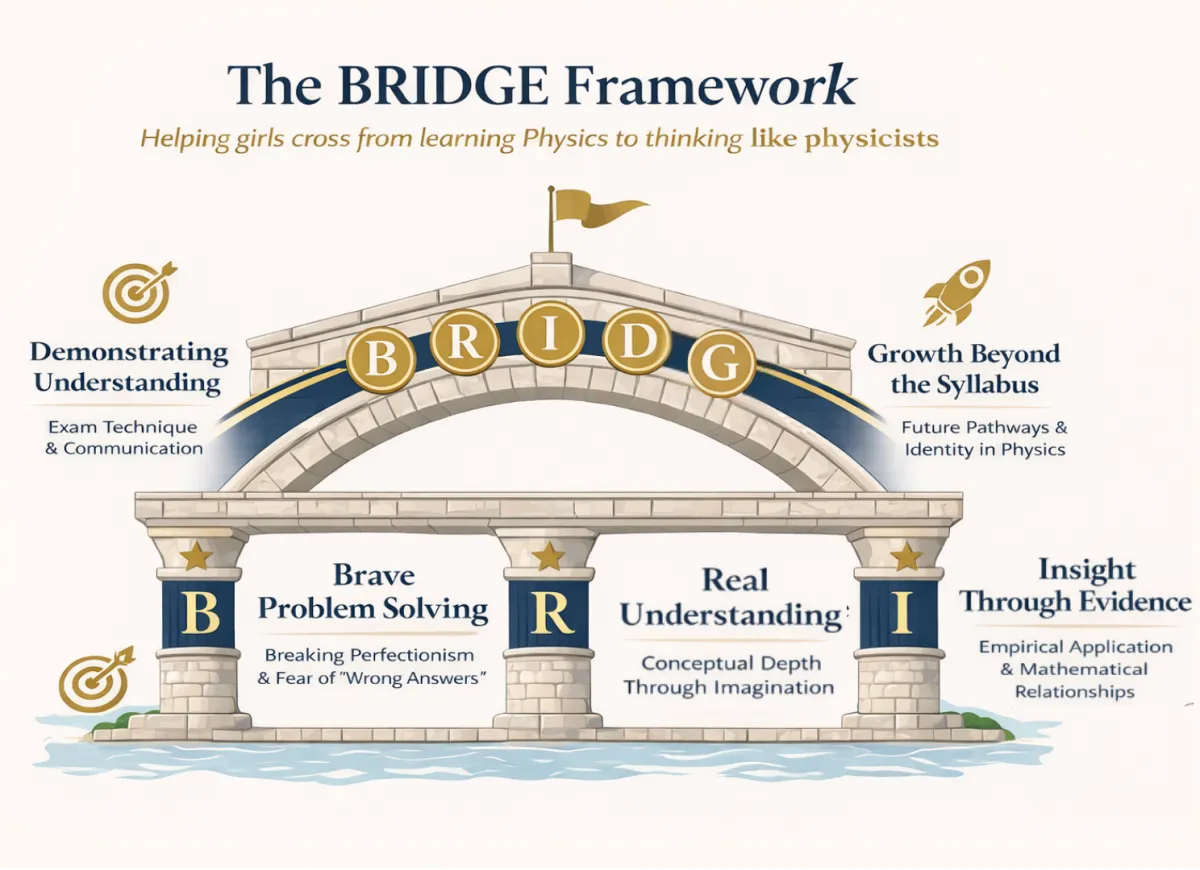
The BRIDGE Framework grew from real classrooms, real results, and a deep belief that girls belong in Physics — and can excel in it.
Ready to Build Confidence in Physics?

Whether you’re looking for structured support, a specialist tutor, or a community that truly understands A-level Physics, you’re in the right place do join my community or book in with me to find out more about I can support you, your department or your child.

A Community Where Girls Belong in Physics

The Physics with Kate Community is a supportive, academically focused space for girls studying A-level Physics.

Inside the community, students have access to:

  • Free BRIDGE-based mini courses

    • Brave and opened - Guided problem-solving sessions

    • Real understanding of the concepts

    • Insight by applying formulas and calculations to solve problems

    • Demonstrate understanding with exam technique support and revision resources

    • Growth, support with UCAS, extra-curricular competitions and projects and industry links

    • Example Visible sixth formers normalise girls in Physics for younger year groups

  • Free to join a network of like-minded girls who take Physics seriously

  • Subscriptions for 1:1 and group tutoring

This is a place where curiosity is encouraged, ambition is normalised, and girls feel confident to ask questions and think deeply.


"I believe a good education can take you anywhere on Earth and beyond" - Ellen Ochoa