Background Radiation, Contamination & Irradiation — Atomic Structure | Physics with Kate
Topic 07

🔮 Background Radiation, Contamination & Irradiation 🔮

Understanding the radiation around us every day, and the critical difference between contamination and irradiation.

✦ Background Radiation

🎬

What Is It?

Background radiation is the low-level nuclear radiation that exists all around us, all the time. It comes from both natural and man-made sources. We must account for it in experiments by measuring it first and subtracting it from readings.

SourceTypeAverage (µSv/year)
Radon gas (from rocks)Natural2.0
Cosmic radiationNatural0.3
Food and drinkNatural0.2
Other natural sourcesNatural0.6
Medical X-raysMan-made0.4
Total3.5

Biggest Source

Radon gas is the largest single contributor to background radiation. It seeps out of certain rocks (especially granite) and can accumulate in buildings. The level varies by location.

✦ Sources of Background Radiation

🩶 Background Radiation Sources — Pie Chart
Radon Gas 57.1% Other Natural 17.1% Medical 11.4% Cosmic Rays 8.6% Food & Drink 5.7% Natural sources Man-made ~88.5% natural, ~11.4% man-made
Background radiation sources in the UK. Radon gas from rocks is by far the largest contributor, accounting for over half of the total dose.
🩺 ✦ 🩺 ✦ 🩺

✦ Contamination vs Irradiation

🎬
☣️ Contamination
The unwanted presence of radioactive materials on or inside an object or person. The radioactive atoms are physically there and continue to emit radiation. Harder to deal with — you must remove or contain the material.
🛡️ Irradiation
Exposure to radiation from a source outside the object. The object does not become radioactive. Once the source is removed, the irradiation stops. Easier to deal with — just move away from the source.
🩶 Contamination vs Irradiation — Visual Comparison
Contamination Material ON / IN the body Continues emitting radiation Harder to deal with — must be removed Irradiation source external External source beams AT object Object does NOT become radioactive Easier — remove source or move away
Contamination means radioactive material is physically present on or in the object and continues to emit. Irradiation is exposure from an external source — the object itself stays clean.

✦ Safety Precautions

Handling Radioactive Sources

  • Wear gloves to prevent contamination of skin (radioactive material getting on you)
  • Use tongs to increase distance from source
  • Keep sources in lead-lined containers when not in use
  • Limit exposure time
🩶 Safety Precautions When Handling Sources
Gloves Prevent contamination Tongs Increase distance Pb Lead Lined Shield & store safely Time Limit Minimise exposure
Four key safety precautions when handling radioactive sources: wear gloves, use tongs, store in lead-lined containers, and limit exposure time.
🩺 ✦ 🩺 ✦ 🩺
Question 1 [1 mark]
What is radioactive contamination?

A. Exposure of an object to nuclear radiation
B. The unwanted presence of materials containing radioactive isotopes on other materials
C. The decay of radioactive atoms
D. The process of cleaning radioactive materials
✦ Answer
B. Contamination is the unwanted presence of radioactive materials on (or in) other materials.
Question 2 [1 mark]
How does irradiation differ from contamination?

A. Irradiation causes objects to become radioactive
B. Contamination exposes objects to radiation
C. Irradiation exposes objects to radiation without making them radioactive
D. Contamination is a type of irradiation
✦ Answer
C. Irradiation is being exposed to radiation from an external source. The object does not become radioactive itself.
Question 3 [3 marks]
Orla carries out a demonstration with radioactive sources and wears plastic gloves. Explain why.
✦ Answer
To prevent radioactive contamination of her skin [1]. If radioactive material got on her skin it would continue to irradiate her cells at close range [1], which could cause cell damage or mutations even after the demonstration ends [1].
Question 4 [2 marks]
Name two natural sources and one man-made source of background radiation.
✦ Answer
Natural: radon gas from rocks, cosmic rays from space (also accept: food/drink, rocks/soil) [1 each].
Man-made: medical X-rays (also accept: nuclear fallout, nuclear power) [1].
Question 5 [2 marks]
A Geiger-Müller tube measures an average background radiation level of 0.3 counts per second. A radioactive sample is placed near the detector and the total reading is 8.3 counts per second. What is the radiation from the sample alone?
✦ Answer
8.3 − 0.3 = 8.0 counts per second [2]. You must subtract the background radiation to find the true count rate from the sample alone.
Question 6 [2 marks]
Using the data table above, calculate the total contribution of natural sources of background radiation.
✦ Answer
2.0 + 0.3 + 0.2 + 0.6 = 3.1 µSv/year [2]. (Cosmic + radon + food + other natural)
Question 7 [2 marks]
Explain why a doctor may recommend a medical X-ray despite the risks associated with nuclear radiation.
✦ Answer
The benefit of diagnosis (finding broken bones, tumours, etc.) outweighs the small risk from the low dose of radiation [1]. The radiation dose from a single X-ray is very small compared to annual background radiation [1].
Question 8 — Diagram Question [3 marks]
The diagram below shows the sources of background radiation in the UK. Use it to answer the following questions.
57.1% Radon 17.1% 11.4% 8.6% 5.7% Sources Radon gas Other natural Medical Cosmic rays Food & drink Total dose: 3.5 µSv/year
Pie chart showing the main sources of background radiation in the UK.
(a) Identify the largest single source of background radiation. [1]
(b) Calculate the total percentage contribution from natural sources. [1]
(c) Suggest why the level of background radiation might be higher in Cornwall than in London. [1]
✦ Answer
(a) Radon gas is the largest single source, at 57.1% [1].
(b) 57.1 + 17.1 + 8.6 + 5.7 = 88.5% from natural sources [1].
(c) Cornwall has more granite rock, which releases more radon gas [1]. This means the proportion from radon is higher there.
Question 9 — Diagram Question [3 marks]
A worker in a nuclear facility encounters two situations, shown in the diagram below. Study the diagram and answer the questions.
Situation A radioactive dust on clothing Worker has radioactive dust on clothes Situation B source open Worker stands near an open source
Two situations a nuclear worker might encounter. Identify which is contamination and which is irradiation.
(a) Which situation shows contamination? Explain your answer. [1]
(b) Which situation shows irradiation? Explain your answer. [1]
(c) State one action the worker should take in Situation A to reduce their risk. [1]
✦ Answer
(a) Situation A is contamination — the worker has radioactive material (dust) physically on their clothing, which will continue to emit radiation [1].
(b) Situation B is irradiation — the worker is being exposed to radiation from an external source. The worker themselves does not become radioactive [1].
(c) The worker should remove the contaminated clothing carefully and wash thoroughly to remove the radioactive material [1]. (Also accept: use decontamination shower, seal clothing in a bag for disposal.)
Question 10 [3 marks]
Explain why radioactive contamination is generally considered more dangerous than irradiation. Your answer should compare how each is dealt with and the risks involved.
✦ Answer
With contamination, the radioactive material is on or inside the body, so it continues to irradiate cells at very close range [1]. The source cannot simply be moved away — it must be physically removed or contained, which is much more difficult [1]. With irradiation, removing the external source or moving away immediately stops the exposure, whereas a contaminated person remains exposed until the material is removed or decays [1].

A Level - February

PHYSICS ONLY

16, 17, 18, 19 Feb 2026

Revision Course

GCSE - Easter

BIOLOGY, CHEMISTRY PHYSICS

7 - 10 April 2026

Revision Course

A Level & GCSE

PHYSICS ONLY

Term - Time

one to one

How You Can Work With Me

Support is offered in clear layers, so students and families can choose what fits best.

Free Community Access

A welcoming starting point with BRIDGE-based resources and introductory courses.

1:1 Specialist A-level Physics Support

Personalised teaching rooted in deep understanding, confidence, and exam success.

Small Group Programmes

Structured learning with motivated peers, focused on thinking, discussion, and application.

Physics With Kate

About Kate

I’m Kate — an experienced Physics teacher, examiner, and the founder of Physics with Kate.

Over more than 15 years, I’ve taught and examined thousands of students and seen first-hand how capable girls can lose confidence in Physics at A-level. I’ve also seen how quickly that changes when teaching focuses on understanding, courage, and belonging.

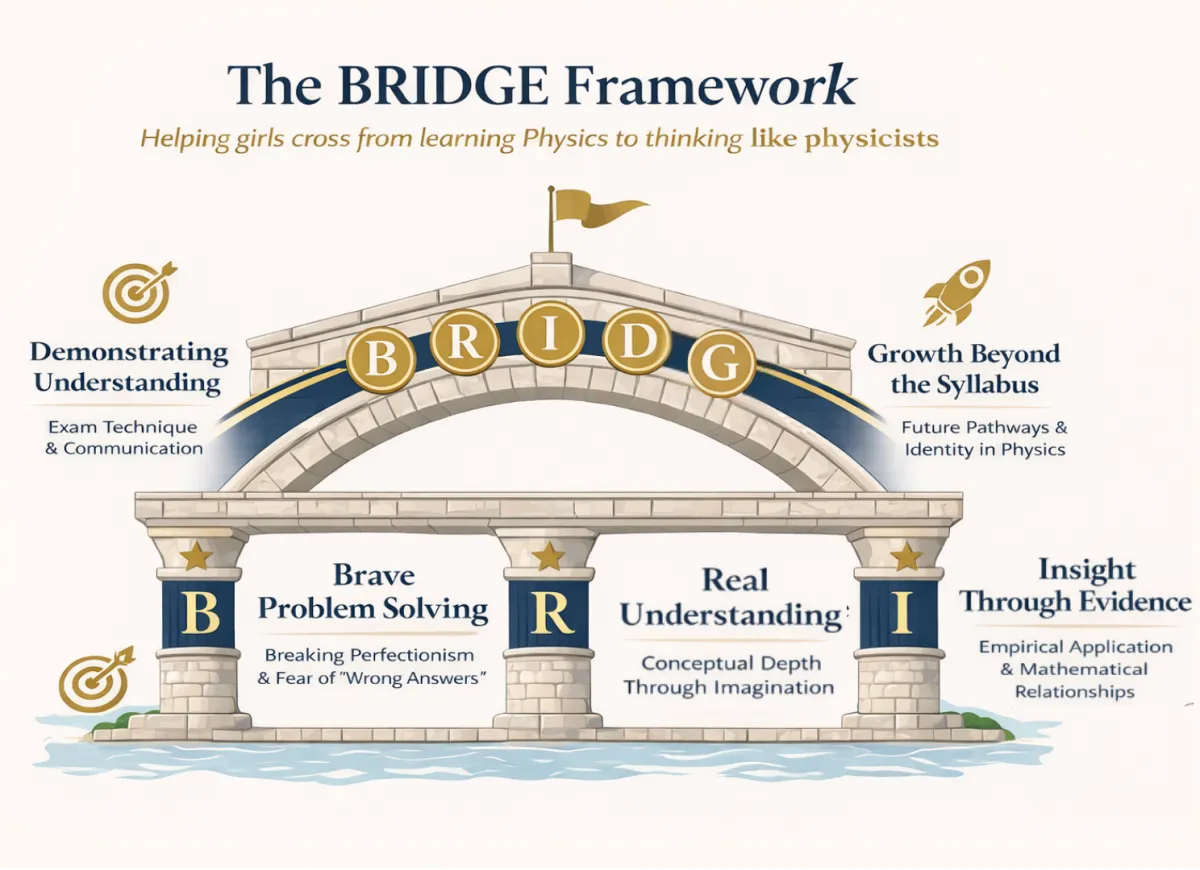
The BRIDGE Framework grew from real classrooms, real results, and a deep belief that girls belong in Physics — and can excel in it.
Ready to Build Confidence in Physics?

Whether you’re looking for structured support, a specialist tutor, or a community that truly understands A-level Physics, you’re in the right place do join my community or book in with me to find out more about I can support you, your department or your child.

A Community Where Girls Belong in Physics

The Physics with Kate Community is a supportive, academically focused space for girls studying A-level Physics.

Inside the community, students have access to:

  • Free BRIDGE-based mini courses

    • Brave and opened - Guided problem-solving sessions

    • Real understanding of the concepts

    • Insight by applying formulas and calculations to solve problems

    • Demonstrate understanding with exam technique support and revision resources

    • Growth, support with UCAS, extra-curricular competitions and projects and industry links

    • Example Visible sixth formers normalise girls in Physics for younger year groups

  • Free to join a network of like-minded girls who take Physics seriously

  • Subscriptions for 1:1 and group tutoring

This is a place where curiosity is encouraged, ambition is normalised, and girls feel confident to ask questions and think deeply.

"I believe a good education can take you anywhere on Earth and beyond" - Ellen Ochoa