
🔮 Half-Life 🔮
The time it takes for half the radioactive nuclei to decay — or for the activity to halve. Calculations, graphs, and the randomness of decay.
✦ Definition
Half-Life (t½)
The half-life of a radioactive isotope is the time taken for half the unstable nuclei in a sample to decay, OR the time for the count rate (activity) to halve.
Radioactive decay is a random process — you cannot predict when an individual nucleus will decay, but with large numbers of nuclei the overall pattern is predictable.
Key Points
- Each isotope has its own fixed half-life — it cannot be changed by temperature, pressure, or chemical reactions
- Half-lives range from fractions of a second to billions of years
- After each half-life, half the remaining unstable nuclei decay
- The activity (count rate) and number of undecayed nuclei both halve each half-life
✦ The Decay Curve
✦ Worked Example
How to Calculate
A radioactive isotope has a half-life of 10 minutes and starts with an activity of 800 counts per second. Find the time for activity to drop to 200 counts per second.
✦ Reading a Half-Life Graph
Method
- Pick any starting count rate on the y-axis
- Find half of that value
- Draw a horizontal line across to the curve, then straight down to the x-axis
- The difference in time = one half-life
- Repeat to check — you should get the same time each time
Don't Forget Background Radiation!
In real experiments, always subtract background radiation from your readings first. The corrected count rate = total count − background count.
✦ Summary: What Halves?
Draw a horizontal line from 240 Bq across to the curve, then draw a vertical line down to the x-axis [1].
The time reads 6 hours. Half-life = 6 hours [1].
Check: 480 → 240 at 6h, 240 → 120 at 12h (another 6h) ✓
Time = 2 × 10 = 20 minutes [1].
(a) Find the half-life of Strontium-90 [2]
(b) State the activity after 3 half-lives [1]
(b) After 3 half-lives: 1000 → 500 → 250 → 125 Bq [1].
(a) After how many hours will the activity of isotope X have fallen to 75 Bq? [2]
(b) After 45 years, what will the activity of isotope Y be? [1]
(b) 45 ÷ 15 = 3 half-lives. 600 → 300 → 150 → 75 Bq [1].
At t=0: 340 − 20 = 320 cpm (corrected) Half of 320 = 160 cpm. Total reading at half = 160 + 20 = 180 cpm [1].
Read from graph: 180 cpm occurs at t = 5 minutes [1].
Half-life = 5 minutes [1].
Check: Corrected 320 → 160 → 80 → 40 at t = 0, 5, 10, 15 min ✓
(a) What is the corrected count rate? [1]
(b) What will the corrected count rate be after 90 minutes? [2]
(b) 90 ÷ 30 = 3 half-lives. 240 → 120 → 60 → 30 counts per minute [1]. Total reading = 30 + 20 = 50 cpm [1].
(b) What is the activity after 24 days? [1]
(c) How many half-lives have passed after 24 days? [1]
(b) Read from graph at 24 days ≈ 50 Bq [1].
(c) 24 ÷ 8 = 3 half-lives [1]. Check: 400 → 200 → 100 → 50 ✓
(b) A radioactive source has an activity of 6400 Bq and a half-life of 3 days. Calculate the activity after 15 days. [2]
(b) 15 ÷ 3 = 5 half-lives [1]. 6400 → 3200 → 1600 → 800 → 400 → 200 Bq [1].
Check: 600 → 300 in the next 10 seconds (halved again) ✓ [1].
Half-life = 10 seconds [1].
At 40 seconds = 4 half-lives: 1200 → 600 → 300 → 150 → 75 Bq [1].
A Level - February
PHYSICS ONLY
16, 17, 18, 19 Feb 2026
Revision Course
GCSE - Easter
BIOLOGY, CHEMISTRY PHYSICS
7 - 10 April 2026
Revision Course
A Level & GCSE
PHYSICS ONLY
Term - Time
one to one
How You Can Work With Me
Support is offered in clear layers, so students and families can choose what fits best.
Free Community Access
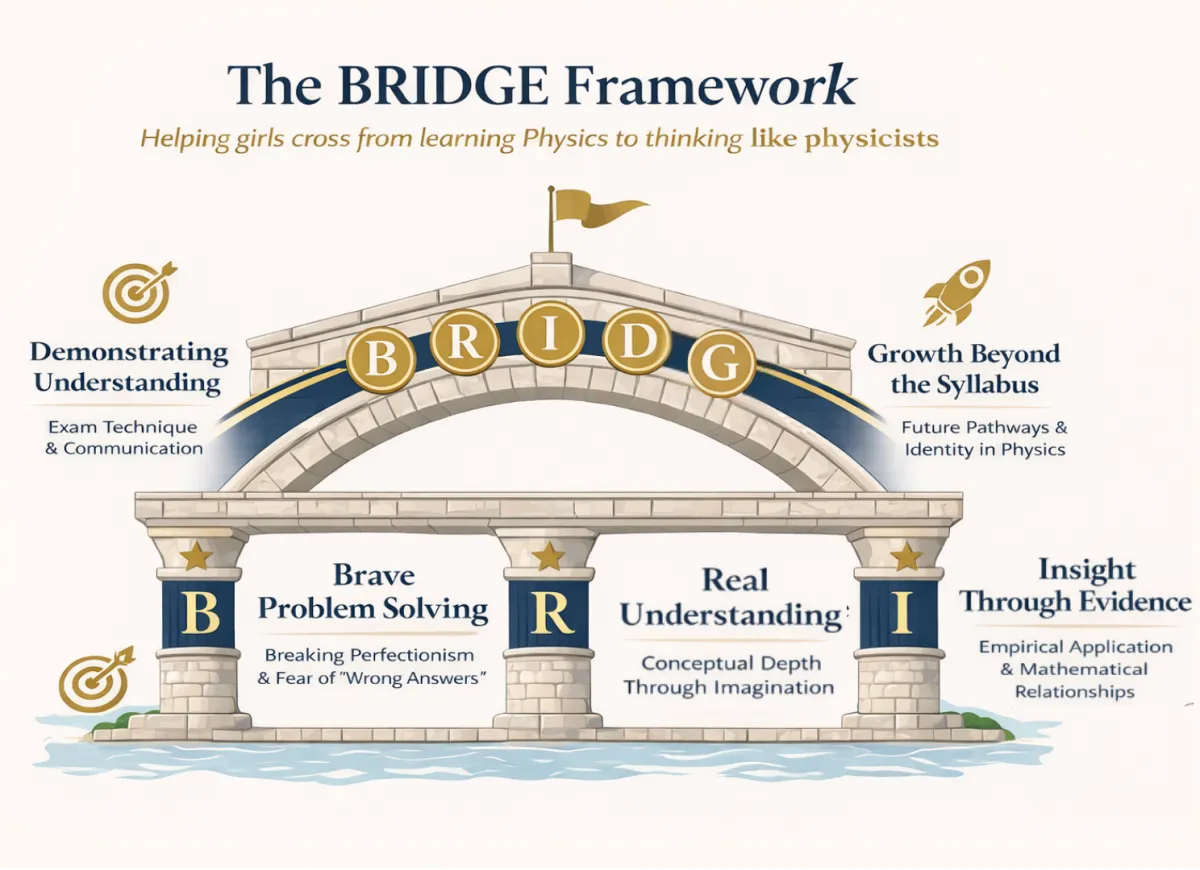
A welcoming starting point with BRIDGE-based resources and introductory courses.
1:1 Specialist A-level Physics Support
Personalised teaching rooted in deep understanding, confidence, and exam success.
Small Group Programmes
Structured learning with motivated peers, focused on thinking, discussion, and application.

About Kate
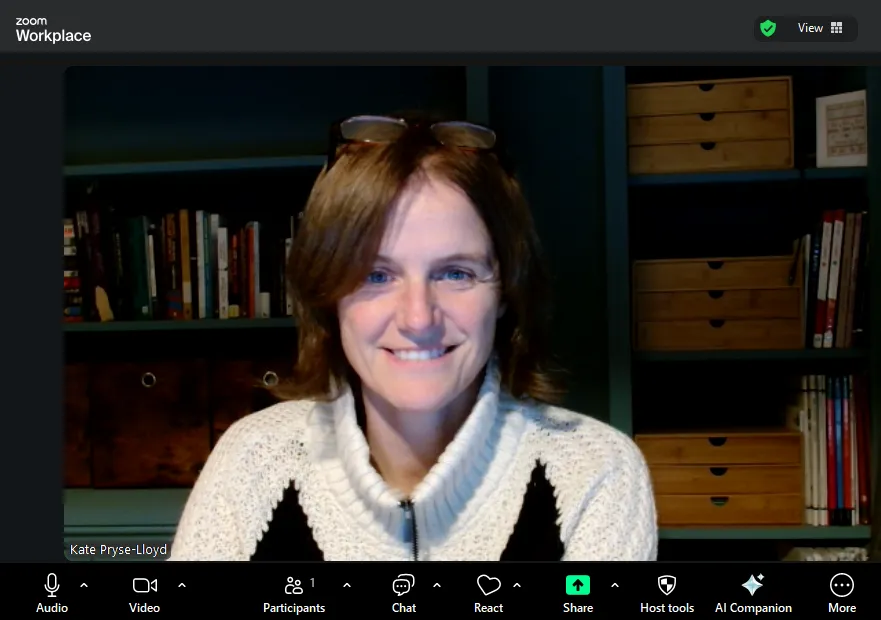
I’m Kate — an experienced Physics teacher, examiner, and the founder of Physics with Kate.
Over more than 15 years, I’ve taught and examined thousands of students and seen first-hand how capable girls can lose confidence in Physics at A-level. I’ve also seen how quickly that changes when teaching focuses on understanding, courage, and belonging.
The BRIDGE Framework grew from real classrooms, real results, and a deep belief that girls belong in Physics — and can excel in it.
Ready to Build Confidence in Physics?
Whether you’re looking for structured support, a specialist tutor, or a community that truly understands A-level Physics, you’re in the right place do join my community or book in with me to find out more about I can support you, your department or your child.
A Community Where Girls Belong in Physics
The Physics with Kate Community is a supportive, academically focused space for girls studying A-level Physics.
Inside the community, students have access to:
Free BRIDGE-based mini courses
Brave and opened - Guided problem-solving sessions
Real understanding of the concepts
Insight by applying formulas and calculations to solve problems
Demonstrate understanding with exam technique support and revision resources
Growth, support with UCAS, extra-curricular competitions and projects and industry links
Example Visible sixth formers normalise girls in Physics for younger year groups
Free to join a network of like-minded girls who take Physics seriously
Subscriptions for 1:1 and group tutoring
This is a place where curiosity is encouraged, ambition is normalised, and girls feel confident to ask questions and think deeply.






Facebook
Instagram
X
LinkedIn
Youtube