How to Revise GCSE Physics Fast: The "Sweep and Drill" Method
How to Revise GCSE Physics Fast: The "Sweep and Drill" Method
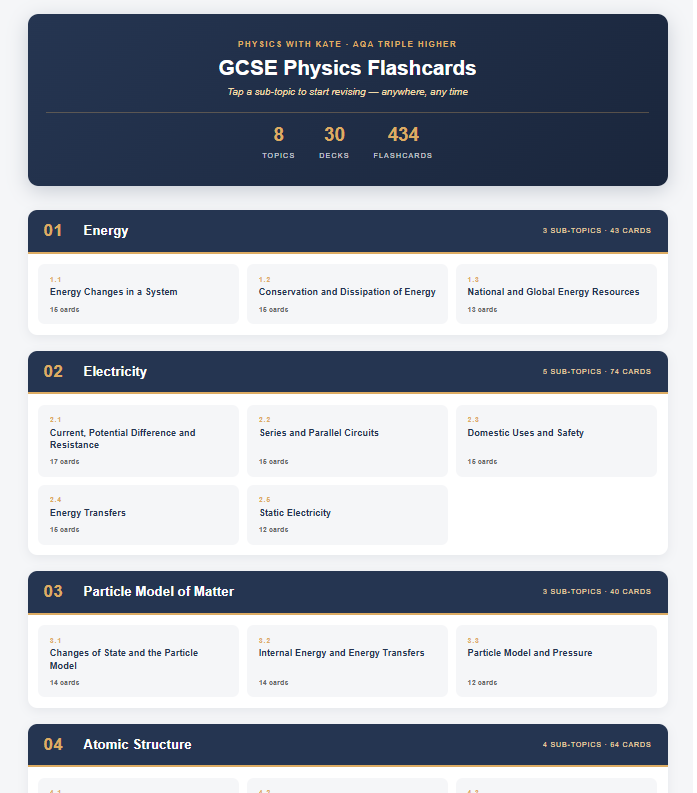
GCSE Physics has 8 topics. Most students start at Topic 1, revise Energy in painful detail, move on to Electricity, then Particles… and run out of time before they reach Space, Magnetism, or Waves. They've revised 3 topics deeply and 5 not at all — and the exam covers all 8.
There's a smarter approach:cover the whole course quickly first, find your weak spots, then drill those. Here's how to do it in roughly two weeks.
Why does linear revision fail in GCSE Physics?
Linear revision (Topic 1 → Topic 2 → Topic 3…) fails because you spend disproportionate time on whatever happened to come first in the textbook. That's almost never where your real weaknesses are. By the time you discover that Topic 7 (Magnetism) is your weakest area, it's already two weeks before the exam.
The solution: a fast pass over everything first, then targeted practice.
What is the "sweep and drill" revision method?
Two simple steps:
Sweep— flick through every topic once, fast (a few seconds per concept), to map what you know vs what you don't
Drill— spend 80% of your remaining time on the topics where you struggled
This mirrors how cognitive scientists say learning actually happens: through deliberate practice of the gap between what you can do and what you need to do.
Step 1 — The Sweep: cover the whole GCSE Physics course in a week
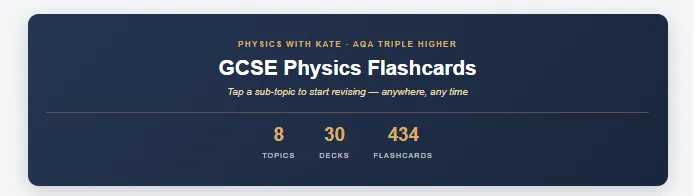
Flashcards are perfect for the sweep. There are ~446 cards covering all 8 AQA Triple Physics topics, mobile-friendly, free.
How to sweep:
For each card, try to answer in your head, then flip and check
Mentally mark each one:🟢 knew it,🟡 sort of,🔴 no idea
At the end of each topic, note the overall feel — solid, wobbly, or blank
This isn't about scoring; it's about mapping. By the end of the sweep you'll know which 2-3 topics are dragging your grade down.
Time required: about an hour a day for a week.
Step 2 — The Drill: spend your time where it actually counts
Once you've identified your weak topics:
Put80% of your remaining revision time into those 2-3 topics
Combine flashcards with your notes, exam questions, and past paper sections
Re-test the same flashcards 2-3 days later — anything still red goes back into the rotation
This is the move that gets students from a 6 to a 7, or a 7 to an 8. Most students never reach this stage because they ran out of time on the linear pass.
Why are flashcards better than re-reading notes for GCSE Physics?
Three research-backed reasons:
Active recall— flipping a card forces your brain to retrieve, which physically strengthens the memory. Re-reading creates a feeling of familiarity that tricks you into thinking you know it.
Spaced repetition— re-tested at intervals, the answer sticks for the long term.
Diagnostic feedback— flashcards instantly tell you what you don't know. Notes never do.
A landmark 2013 review in Psychological Science in the Public Interest ranked active recall and spaced practice as the two most effective revision techniques out of ten studied. Re-reading and highlighting came near the bottom.
How do I know which GCSE Physics topics I'm weakest in?
Sweep the whole set once and watch where your reds cluster. Common weak topics for AQA Triple students:
Topic 4 — Atomic Structure(radiation types, half-life, nuclear equations)
Topic 5 — Forces(especially momentum and Newton's laws maths)
Topic 7 — Magnetism and Electromagnetism(motor effect, transformers)
These tend to be later in the textbook so they get less revision time.
Try it now — free GCSE Physics flashcards
I've put together a free flashcard pack covering all 8 AQA Triple Physics topics, with mark-scheme-precise wording. Mobile-friendly so you can revise on the bus, in a queue, or before bed.
👉Start the Sweep — GCSE Physics Flashcards
An hour today is an hour of your weakest topics found.
FAQ
How long should I revise GCSE Physics for?
Aim for 4-6 weeks before the exam. The sweep and drill method needs about 1 week for the sweep, 2-3 weeks drilling weak topics, and a final week of timed past papers.
What's the best way to revise GCSE Physics?
The most effective techniques (according to research) are active recall and spaced repetition. Flashcards do both at once. Re-reading notes feels productive but creates the illusion of knowing the material without actually learning it.
Should I use past papers or flashcards for GCSE Physics?
Both, in this order: flashcards first (to find what you don't know), then past papers (to apply it under exam conditions). Doing past papers before you know the content is demoralising and not very useful.
Are these flashcards aligned to the AQA Triple Higher specification?
Yes — all 8 topics, all 30 sub-topics, with depth matched to AQA Triple Higher.
How long does the sweep take?
Most students cover ~25-30 cards per hour if they're being honest. The full set is around 15 hours of sweep time, normally spread over a week — an hour a day.
Can I do the sweep and drill method for other GCSE subjects?
Absolutely. The principle works for any subject with discrete topics — Biology, Chemistry, History, Geography, anything. The flashcards just need to cover the whole spec.


