
How to Get an A* in A Level Physics (Without Working Twice as Hard)
How to Get an A* in A Level Physics (Without Working Twice as Hard)
"How can I get an A* in my A Level Physics?" is the question I get asked more than any other. There's no single magic trick — but there is one small habit that costs almost no extra time and consistently lifts students up by a grade boundary:knowing your definitions, word-for-word, the way the examiner wants them.
Stick with me — the maths is genuinely surprising.
How big is the gap between an A and an A* in A Level Physics?
In Edexcel A Level Physics, the A grade boundary sits at around70%and the A* boundary at around80%. Boundaries shift a few marks each year, but the pattern is stable. Across the three papers there are roughly 270 marks in total, so:
A grade ≈ 189 marks
A* grade ≈ 216 marks
Gap between them: ~27 marks
That's nine marks per paper. Not a chasm — and this is where definitions come in.
Why are definitions the lowest-hanging fruit on an A Level Physics paper?
Every Edexcel paper has questions that ask you to define or state what is meant by a key term —electromotive force, internal energy, photon, stress, Young's modulus, half-life, binding energy. They're usually 1-2 marks each.
Examiners mark these strictly. They have a word-for-word definition on their mark scheme, and they tick the marks only if your wording captures it. Get the wording slightly wrong, leave a key word out, and you lose the mark — even if you "kind of know it".
A typical paper has4-8 marks worth of definition-style questions. Across three papers, that's potentially12-24 marks that come down purely to whether you can recite the right wording.
12-24 marks. From a gap of 27. You can see where this is going.
"But I understand the physics — isn't that enough?"
This is the trap most students fall into. Knowing what something means in your head is different from knowing how to write the definition the way the mark scheme wants it. Examiners aren't grading your understanding — they're grading what you wrote on the page.
Two quick examples:
Stress.Most students write something like "the force on something divided by area". The mark scheme wants:force per unit cross-sectional area acting normal to the surface of a material. Without "per unit", "cross-sectional", and "normal to the surface", no mark.
Photon.Students often say "a tiny bit of light". The mark scheme wants:a discrete packet of electromagnetic radiation energy. "Tiny bit" doesn't earn marks; "discrete packet" does.
Once you see the pattern, fixing it is fast.
How do you learn A Level Physics definitions efficiently?
The mistake most students make is reading their notes over and over. That doesn't transfer to recall under exam pressure. What actually works:
Active recall— cover the definition, write it from memory, check, repeat
Spaced repetition— revisit the same set after 1 day, 3 days, 1 week
Test before, not after— recall before you re-read is when the learning happens
Flashcards built around active recall are the fastest way to do all three. Twenty minutes a week, all year, and by exam season the wording is locked in.
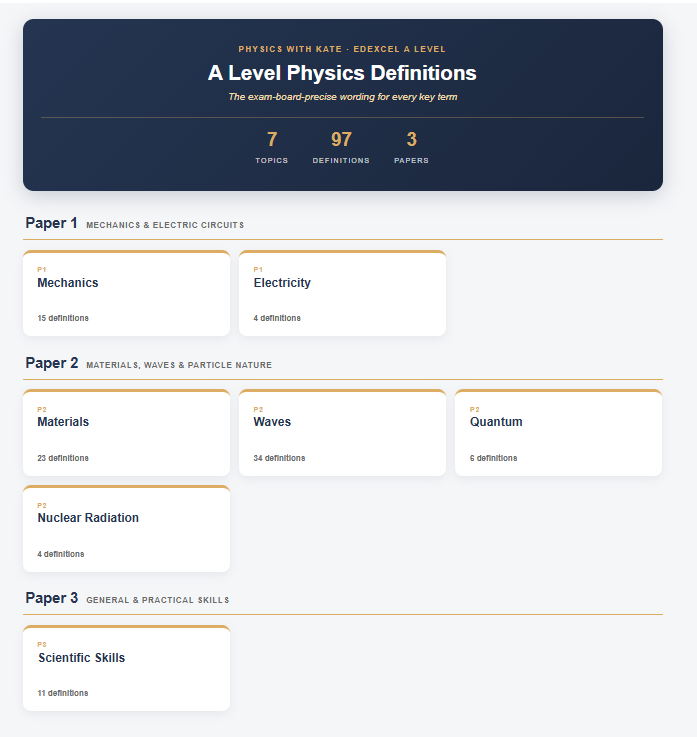
Try it now — free A Level Physics definition flashcards
I've put together a flashcard pack of every key Edexcel A Level Physics definition — the exact wording examiners want — split by paper and topic. Front of each card: the term. Back: the mark-scheme-precise definition.
👉Start revising — A Level Physics Definitions Flashcards
Twenty minutes here, one mark there, another mark there — and suddenly you've crossed a grade boundary.
FAQ
How many definition marks are in an A Level Physics paper?
Typically 4-8 marks per paper, depending on the year. Across three Edexcel papers that's around 12-24 marks of pure definition recall.
Do I need to memorise A Level Physics definitions word-for-word?
Yes. Examiners use strict mark schemes — the exact wording matters. Knowing the meaning isn't enough; you have to write it the way the mark scheme reads.
Where can I find official Edexcel A Level Physics definitions?
The Edexcel specification and past mark schemes are the official source. I've compiled them into a free flashcard pack :physicswithkate.com/a-level-edexcel-flashcards.
Can knowing definitions really raise my A Level Physics grade?
Yes. The gap between A and A* in Edexcel A Level Physics is usually around 27 marks across three papers. Definition marks alone account for 12-24 of those. If you're close to a grade boundary, definitions alone can lift you across it.
Does this work for AQA and OCR too?
The same principle applies — every UK exam board strictly mark-schemes definitions. The wording for some terms differs slightly between boards, so use the flashcards specific to your board.


